

The Complete History of Graffiti
Welcome to the ultimate deep dive into the evolution of the tag. While many see graffiti as a modern phenomenon of the 1970s, its roots reach back centuries, from the scratched ruins of Pompeii to the clandestine codes of the American rail system.
In this guide, we’re moving beyond the basics to explore the pivotal shifts in culture, the high-stakes competition of the New York subway era, and the technological leaps that transformed a “scourge” into a globally celebrated art form. Whether you’re an aspiring writer or a dedicated historian of the streets, let’s trace the journey of how a simple signature became a revolution.

Table of contents
- Where did the term “graffiti” come from?
- Early uses and purposes of graffiti
- The New York graffiti boom
- Evolution of graffiti styles and sizes
- The 80s lull and British resurgence
- Modern graffiti success
- Learn more about graffiti at Graff City
Where did the term “Graffiti” come from?
If you thought graffiti was a modern phenomenon, think again. The word ‘Graffiti’ is derived from the Greek ‘Graffein’, meaning to write, draw, or scratch, and the label predated the arrival of Cornbread in Philadelphia in the late 1960s. In fact, the term was first coined in 1851 when inscriptions were found scratched into the walls of the ruins of Pompeii.
Early uses and purposes of graffiti
Graffiti, in its crudest form, was used by people experiencing homelessness to communicate with one another while travelling the country on freight trains, looking for work. Many of them couldn’t read or write, so they developed a ‘language’ of their own, leaving messages near train tracks, railway bridges, and known meeting places. These codes, which consisted of symbols and pictures, would warn others of police presence in the area or grading camping spots.
The Berlin Wall

Graffiti is often found on city walls and trains worldwide. Before the Berlin Wall was destroyed in 1989, the two sides of the wall separating East and West Germany were starkly different. The East side of the wall was unapproachable; a Death Strip was in place to prevent anyone from approaching it and attempting to escape. But on the West face of the wall, there were no such deterrents, allowing people to approach the wall at will, which led to a vibrant display of art and commentary.
Cornbread
A few years after the Berlin Wall went up in 1961, activists in other parts of the world used graffiti to make political statements. Street gangs also used it to mark their territory, but it wasn’t until the late 1960s that it became more prevalent. A teenager, Darryl McCray, who went by the name of ‘Cornbread’, and his friends started writing their nicknames, or ‘tags’, all over Philadelphia. This act took graffiti out of gangs’ hands and into the streets. Cornbread was the first to tag his own name rather than a gang name or symbol.
After developing a crush on a girl, Cornbread took to writing ‘Cornbread Loves Cynthia’ all over the city; his perseverance paid off, and Darryl won his girl!
The New York graffiti boom
Nobody really knows how graffiti spread to New York, but in 1971, the New York Times published an article about a writer known as TAKI 183. TAKI was derived from his full name, Demetrius, and the 183 referred to his address. TAKI spent a lot of time on the subway, travelling around the city as a foot messenger, and he used this time to tag wherever he went.

Although not the first graffiti writer in New York, he was the first to be recognised outside graffiti circles when his tags sparked public curiosity, and the newspaper covered the story.
Writing became competitive. The subway linked all the boroughs, and writers from all over the city began to recognise each other’s work, giving rise to competition. Graffiti spread from walls to subway trains, and writers began competing to see who could tag the most trains; a concept known as bombing.
Evolution of graffiti styles and sizes
As the number of writers on the streets multiplied, the simple act of tagging evolved into a high-stakes game of visual dominance. It was no longer enough just to be everywhere; you had to be the best. This creative arms race led to a rapid explosion of typography, scale, and complexity that pushed the limits of the spray can.
- The Birth of Style: Writers began moving beyond basic handwriting to incorporate calligraphy and artistic flourishes such as stars, polka dots, and crowns—the latter a symbol reserved for those who considered themselves “Kings” of a line.
- Iconic Signatures: Unique flourishes became trademarks; for example, the legendary STAY HIGH 149 famously incorporated a “joint” into his signature.
- Dimensionality and Scale: As writers sought greater impact, they abandoned thin letters in favour of three-dimensional aesthetics. This era saw the rise of the soft, rounded Bubble style and the elongated, sophisticated Broadway style.
- Mechanical Complexity: Simple letters eventually gave way to Mechanical lettering, a precursor to the incredibly intricate designs that would later be known as “Wildstyle”.
- The Rise of the Mural (1974): Tagging expanded into full-scale art as writers began adding scenery, characters, and detailed illustrations to their work.
- The “Bombing” Peak (1975–1977): Aided by a struggling New York economy that left subway cars uncleaned, writers began “bombing” entire trains with massive murals, ensuring their art travelled through every borough.
The 80s lull and British resurgence
Things really quietened down on the graffiti front in the early 1980s. Several factors came into play simultaneously: the Metropolitan Transit Authority developed an anti-graffiti policy that made access much more difficult; removal and repair were much swifter; and train yards were heavily guarded. The sale of paint to minors was made illegal, and penalties were increased. In addition to these factors, crack cocaine was becoming an epidemic, and things became much more tense; firearms were carried with much more frequency because of the drug culture, and many writers simply walked away from the scene.
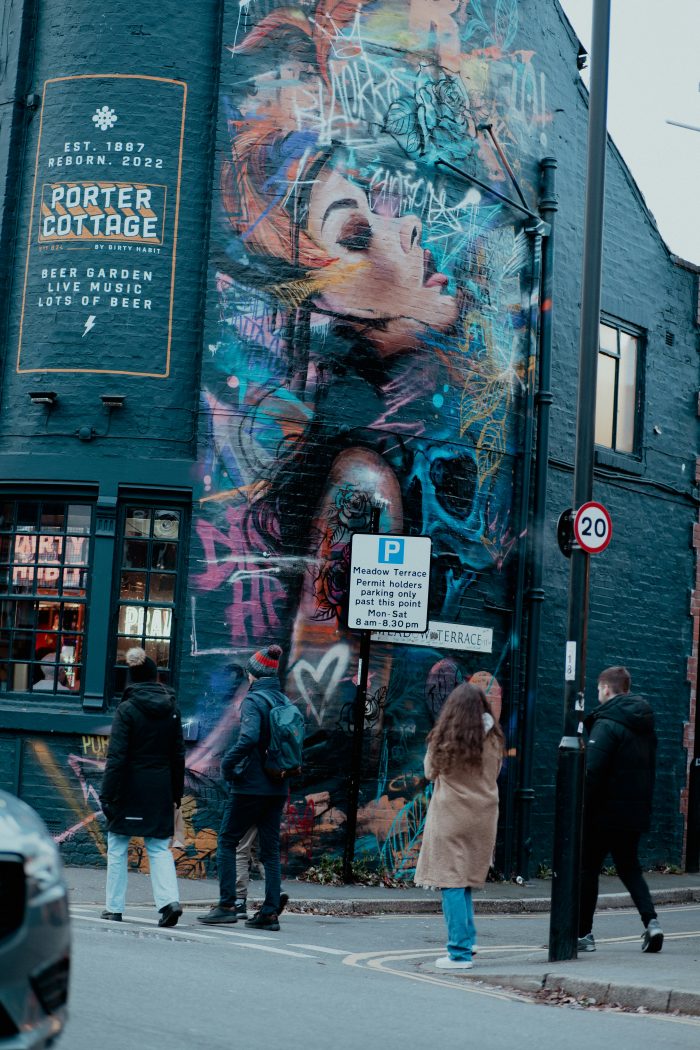
However, it didn’t take long for graffiti to migrate to the UK. In the late 1980s, hip-hop and electro music began to gain popularity, and with it came street art. By the 1990s, spray paint was custom-made, allowing writers to make their mark with even more elaborate art. One of the UK’s early crews was the DryBreadZ Crew, and the most famous graffiti writer of all time, Banksy, began as a member of the crew.
Not only was spray paint more ‘graffiti-friendly’, but so were other materials, which allowed writers to get their work up as fast as possible. Stencils and stickers were used, allowing artists to enter and exit without being caught by the police.
Modern graffiti success
In 1972, a sociology major at City College named Hugo Martinez recognised the potential of Graffiti as a legitimate art form and founded the UGA, which showcased some of the writers’ work in an art gallery, giving them opportunities that would otherwise have been out of reach.
Although Martinez paved the way for many graffiti writers and artists to be taken seriously, it wasn’t until the 2000s that it was widely recognised as a credible art form. Suddenly, art collectors wanted street artists to do commissioned pieces for them, and graffiti became a legitimate means of earning money. Many artists dropped their tags and began creating art under their real names to build professional reputations.
The internet has, for the most part, done away with the anonymity of street artists, and young people are building a career out of what was once considered a scourge.
Learn more about graffiti at Graff City
The history of graffiti is still being written every day on walls across the globe. If this deep dive has sparked a desire to see more, your education doesn’t have to stop here.
At Graff City, we are dedicated to preserving the culture and providing the tools for the next generation of artists. Explore our extensive media collection to immerse yourself in the legends of the scene. We stock a curated selection of graffiti books that offer rare looks into artist archives, alongside the latest magazines to keep you up to date with modern global trends.
Feeling inspired to make your own mark? Transitioning from a fan to a creator starts with the right medium. Check out our industry-leading spray paint collection—featuring the same professional-grade cans that turned graffiti from a local hobby into a worldwide phenomenon.

Comments are closed here.